Day Three: Hydrogen Vehicles

Hydrogen makes me think of things like.. the number one, the letter "H", wonderful days of High School and College Chemistry, and of course, the Hindenburg. As it turns out Aluminum had more to do with the Hindenburg accident than Hydrogen so we'll leave it off the list. So how exactly is Hydrogen going to be the next magical substance to make rainbows and make Al Gore smile?
The idea behind Hydrogen powered vehicles is that either 1) they use Hydrogen for combustion alongside gasoline (petrol, for those in the UK) or 2) Hydrogen be used in fuel cells, forced to react with Oxygen which would create a water byproduct and generate electricity to run an engine. [Forgive me if I've oversimplified the processes, these are just description for the Average Joe (or Jane)]

The first method, the gasoline/hydrogen combustion engine, is being used in the beautiful, new BMW Hydrogen 7 (pictured above). This seems to be a pretty good idea, creating a true hybrid vehicle however there are some issues in the realities of this method. First, a passable infrastructure for the mass manufacture and distribution of Hydrogen is about 15 to 20 years away. Second, the hydrogen tank is normally under pressure however, if the car is not used for 17 hours the tank begins to lose pressure and leak out the hydrogen - meaning that if you don't use your car for about 4 or 5 days in a row, your tank will be empty. Thirdly, the process to create and distribute Hydrogen to fueling stations is itself very inefficient. In fact, according to experts in the field it is about 1/4th as efficient as using battery technology and a little less efficient than the current hydrogen fuel cell technology. Overall, I like the idea but unless a major breakthrough happens in the storage and infrastructure of hydrogen fueling stations.. it will remain an Al Gore fantasy not reality.
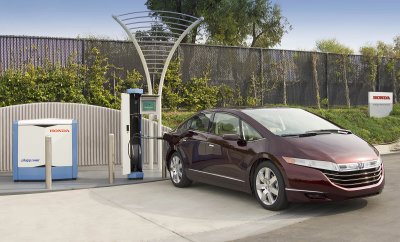
The second method is using Hydrogen in a fuel cell, react it with Oxygen and water leaks out the tail pipe as electricity runs your motor. This is the more popular vein of hydrogen technology automakers are trying to adapt (such as the Honda FCX pictured above).
Again, most problems with Hydrogen fuel cells is that the technology just isn't caught up to reality. 1) The fuel cell technology is currently prohibitively expensive (they contain platinum and other rare metals) in exchange for comparative performance to most of today's autos. 2) The hydrogen fuel cells are very brittle and weak and cannot handle even the normal bumps and vibrations of an average road. 3) The fuel cells can't stand up to cold weather especially freezing conditions because that impedes their start-up process and the byproduct of the process is water.. which freezes causing some problems in exhaust. 4) The infrastructure is neither in place nor is there a comprehensive plan to implement to get hydrogen stations allover the country. 5) Other fuel cell technologies are far more efficient in a comparison done by MIT's Technology Review in 2007 of grid-to-motor efficiency electric hybrids were 86% efficient in comparison to 25% for the hydrogen fuel cell vehicles.
Ouch... There we go. More than a few reasons why "green" cars are not quite what they are portrayed as, instant band-aids to the world-wide crunch. What is the solution then? Well, until technology and innovation catch up with the dreams of the automobile industry there are a few steps that we can take to curb both pollution and the dependence on oil. You can: ride public transport, drive slower.. you get more MPGs, buy a vehicle that actually fits your lifestyle - no SUVs for Soccer moms and no enormous trucks for guys who will never haul anything, stay smart make less trips with your vehicle by combing them and planning them out. There are plenty more tips I'm sure floating around in the interwebs and if you care to scratch the surface.. you will be flooded.
Link: The Last Car You Would Ever Buy -- Literally - MIT's Technology Review


